
Introduction
We have all done it. You are pulling into a tight car park in Melbourne’s west, or turning a corner a bit too sharply, and, bump, your tyre scrapes or knocks against a kerb. Most drivers just keep going. But wheel alignment after hitting a kerb is one of those things you should never ignore, even if your car seems fine.
A soft knock can move your wheels out of place without you even noticing. Left unchecked, this can wear out your tyres early, make your car harder to steer, and even become a safety risk. This guide will explain what happens when you hit a kerb, the signs to look for and what to do if you hit one.
What Happens When Your Car Crashes into a Kerb?
Your suspension and steering system are what keep your wheels in place. These are tie rods, control arms, and struts. They work together to keep each wheel sitting at the angle the manufacturer intended.
When a tyre strikes a kerb, that force travels straight through the wheel and into these parts. Even a slow, gentle bump can be enough to nudge something out of place. You do not need a big crash for this to happen; a low-speed scrape while parking or turning is often enough.
Sometimes the damage is obvious, like a scuffed rim or a dented hubcap. Other times, everything looks normal on the outside, but the alignment underneath has already shifted.
Cars with low-profile tyres are especially at risk. These tyres have less rubber between the rim and the road, so there is less cushioning to soak up the impact. If your car has larger wheels and thinner tyres, it is worth being extra cautious around kerbs and tight car parks.
The angle you hit the kerb at also makes a difference. A straight-on bump at low speed is usually less serious than a sideways scrape while turning. A sideways hit can twist the wheel and place uneven pressure on the suspension parts.
Signs You May Need a Wheel Alignment After Hitting a Kerb
Your car often tries to tell you something is wrong. Here are the most common signs to watch for after a kerb strike.
Your Steering Wheel Sits Off-Centre
If your steering wheel is no longer straight when your wheels are pointing forward, this is one of the clearest signs of a car wheel alignment problem. You might notice the wheel sits slightly to the left or right, even on a straight, flat road.
Your Car Pulls to One Side
Take your hands lightly off the wheel on a quiet, straight stretch of road (only if it is safe to do so). If your car drifts left or right on its own, your alignment has likely changed.
Uneven or Fast Tyre Wear
Vibration or Noise While Driving
Sometimes there is no single obvious symptom. The car may just feel a little heavier to steer, or less stable than usual. Trust that instinct; it is worth getting checked.
The Car Feels "Different" to Drive
A knock from a kerb can bend a rim or shift a wheel slightly. This can cause a subtle vibration through the steering wheel, especially as your speed increases.
Why It's Dangerous to Ignore Wheel Alignment
When it’s just a minor knock and the car still seems to drive fine, it’s easy to brush off. But misaligned wheels are a safety issue, not just a comfort one.
Any imbalance in wheel angles places additional stress on tyres, increasing their wear. This means tyres wear out faster and need replacing sooner, costing you more in the long run.
Additionally, the alignment affects how your car handles in an emergency. For good handling and grip, your tyres need full, even contact with the road. This is especially important when you need to stop or turn quickly to avoid danger.
Roadworthiness rules matter here too. The NSW Government’s roadworthiness guidelines state that your tyres must not be worn unevenly and must have a tread depth of at least 1.5mm to be considered roadworthy. Separately, Transport Victoria’s tyre standards confirm that a tyre must not have excessive uneven wear across its width. Misaligned wheels are a common cause of exactly this kind of uneven wear, which is one reason a kerb strike is worth checking rather than ignoring.
Transport Victoria also confirms that tyres play a critical role in braking, steering, and cornering. Since wheel alignment affects how your tyres sit and grip the road, keeping it correct supports the same safety standards Transport Victoria is talking about.
What Happens During a Wheel Alignment
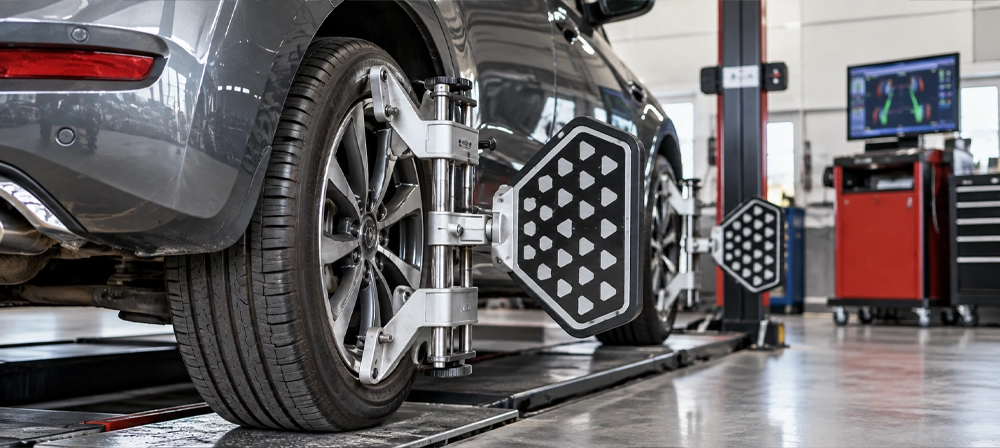
Car wheel alignment is a straightforward process. A technician places your car on a special alignment machine that measures the angle of each wheel compared to the manufacturer’s specifications.
If any wheel is out of range, the technician makes small adjustments to bring it back into line. If your kerb strike was hard enough to bend a rim, damage a tie rod, or crack a wheel, an alignment alone will not fix the problem. In these cases, the damaged part needs to be repaired or replaced first, then the wheels are aligned. Colonial Collision Centre offers alloy wheel repair services in Brooklyn for exactly this kind of damage.
When a Kerb Strike Means More Than Just Alignment
Not every kerb hit stays contained to the wheels. A harder knock can also damage your bumper, wheel arch, suspension arm, or steering components. According to Colonial Collision Centre’s guide on smash repair versus panel beating, a smash repairer’s work includes wheel alignment and suspension checks alongside structural and mechanical repairs, which is why a proper assessment after a harder kerb strike often involves more than a standalone alignment.
A good repairer will check the whole area around the impact, not just the tyre and rim. This makes sure nothing hidden, like a bent control arm, gets missed and causes problems further down the road. You can read more about the difference between the two types of repairers on the Colonial Collision Centre blog.
If you notice any scraping, a dented panel, or a wheel sitting at a slightly different angle to the others, it’s worth having the car properly assessed. Don’t just book a standalone alignment.
Important: Prices are indicative for 2026 and vary by vehicle, panel location, and paint type. Contact us for an accurate quote.
These are general ranges. Your actual quote depends on the make and model of your vehicle, the panel location, paint colour complexity (metallics and pearls cost more to match), and whether any parts need ordering.
Think Your Car Needs a Closer Look?
Our team can check your wheels, suspension, and bodywork all in one visit, so nothing gets missed.
Simple Steps to Take After Hitting a Kerb
If you have just clipped a kerb, here is what to do next.
Pull Over Safely and Check for Obvious Damage
Look at your tyre for cuts, bulges, or a flat spot. Check that the rim is not visibly bent or cracked.
Drive Carefully to Your Next Stop
If everything looks okay, drive gently and pay attention to how the car feels. Avoid high speeds until you are confident nothing is wrong.
Watch for Symptoms Over the Next Few Days
Sometimes alignment issues take a day or two to show up clearly. Keep an eye out for pulling, vibration, or uneven tyre wear.
Schedule a Professional Check
Even if the vehicle looks fine, a quick alignment check will put your mind at ease. It’s a simple step that can save you money and stress down the road.
Final Thoughts
Clipping a kerb might seem minor, but it can gradually knock your wheels out of alignment and wear down your tyres. Watching for the warning signs and getting your car checked sooner rather than later keeps you safer on the road and helps your tyres last longer.
If you are in Brooklyn or Melbourne’s western suburbs and want peace of mind after a kerb strike, the team at Colonial Collision Centre can check your wheel alignment, suspension, and bodywork all under one roof. You can find their full range of services or get in touch directly to book a check.
Frequently Asked Questions
How do I know if hitting a kerb has affected my wheel alignment?
Watch for a steering wheel that sits off-centre, your car pulling to one side, uneven tyre wear, or a vibration while driving. If you notice any of these, it is worth getting your alignment checked.
If a car hits a kerb, will it be safe to continue driving?
If the tyres and rims look fine, with no visible damage to the body, it should be safe to keep driving, just take it easy. It’s still worth getting a check-up soon, as some alignment issues won’t be obvious straight away.
How often should I get my wheels checked after hitting a kerb?
Colonial Collision Centre recommends having your wheels checked at least once a year, and straight away if you’ve recently hit a kerb or a bump.
Can hitting a kerb cause damage beyond the wheels?
Yes. A hard enough impact can affect your suspension and steering components, and even your bumper or wheel arch. Colonial Collision Centre’s guide to smash repairs explains that this kind of damage is typically handled by a smash repairer rather than a standalone wheel aligner.
What shops in the area of Brooklyn or Melbourne West offer wheel alignment services?
Colonial Collision Centre is at 11 Export Dr, Brooklyn VIC 3012, and they can be contacted by phone on (03) 9348 9222 or by using their contact form.
2 Responses
**TraceEagle — Free, All-Platform Network Packet Capture & Debugging Tool**
– Raw packet capture at the NIC level: DNS, QUIC, TCP/UDP — nothing slips through, granularity on par with Wireshark
– Auto-decrypts on capture: no proxy setup, no key import, no environment config — ciphertext becomes plaintext instantly
– Built for the hard cases: no jailbreak, no cert install, bypasses certificate pinning, decodes HTTP/3 & QUIC
– Full debugging toolkit: breakpoint editing, request replay, one-click load testing (true p99), reverse-engineer OpenAPI from traffic, generate code
– AI-powered capture: built-in MCP service exposing 40+ tools as APIs — let your AI assistant capture and debug on demand
Free across all platforms. Perfect for integration testing, mobile app debugging, API security, load testing, and network troubleshooting.
**TraceEagle — Free, All-Platform Network Packet Capture & Debugging Tool**
– Raw packet capture at the NIC level: DNS, QUIC, TCP/UDP — nothing slips through, granularity on par with Wireshark
– Auto-decrypts on capture: no proxy setup, no key import, no environment config — ciphertext becomes plaintext instantly
– Built for the hard cases: no jailbreak, no cert install, bypasses certificate pinning, decodes HTTP/3 & QUIC
– Full debugging toolkit: breakpoint editing, request replay, one-click load testing (true p99), reverse-engineer OpenAPI from traffic, generate code
– AI-powered capture: built-in MCP service exposing 40+ tools as APIs — let your AI assistant capture and debug on demand
Free across all platforms. Perfect for integration testing, mobile app debugging, API security, load testing, and network troubleshooting.
Try it → [https://traceeagle.com/](https://traceeagle.com/)