
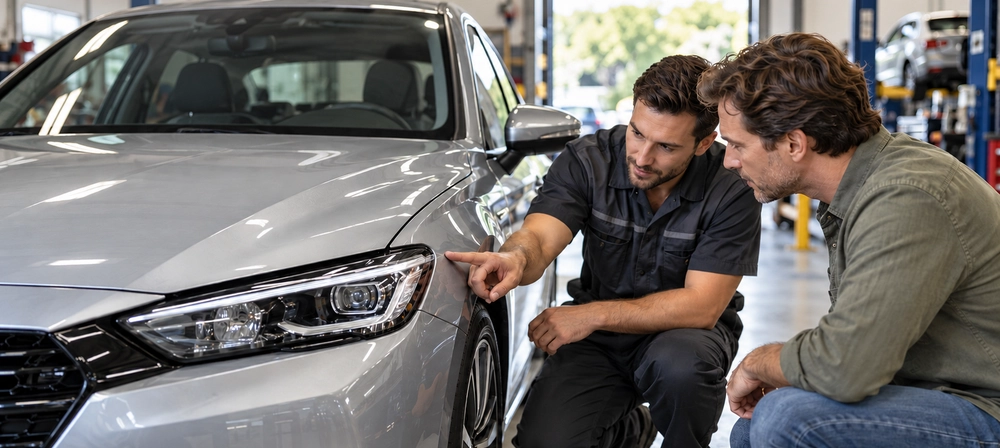
You get about ten minutes at handover, and they are the most useful ten minutes of the whole job. Judging car repair quality is mostly a matter of light, angles and patience. Look at the paint in daylight, sight down the panel gaps, open and close everything, and ask for the paperwork before you sign.
This is written for drivers collecting a car after a collision repair in Melbourne’s west. It covers what a car repair inspection can show you, what it cannot, and the questions that cover the rest.
Daylight is the only honest light for a car paint repair
Workshop lighting flatters paint. Get the car outside, or into open shade, before you look at anything.
Then move. Walk the full length of the panel, crouch to a low angle, and look again from above. Paint makers tell their own painters to do exactly this. PPG’s colour-match guidance says to compare a test panel “with the original at different angles and in differing light”. Metameric distortion — “colour variation in differing light” — is one of its listed causes of a poor colour match.
Compare the repaired panel against an untouched one on the same car, not against your memory of the colour. A door that matches its own guard from three angles is a good sign. One that matches from a single angle is worth a question.
Three finish faults are easy to spot once you know the words for them:
- Orange peel — PPG describes it as a “pebbled, uneven surface of the paint film, similar in appearance to orange skin”. Factory paint has some texture of its own, so the question is not whether texture exists. It is whether the repaired panel matches the panel next to it.
- Dry spray — “a granular or coarse textured finish with no gloss”, caused by paint landing in a powdery condition. Run the back of a clean hand lightly across the repair and then across an original panel. Your hand will find it before your eye does.
- Overspray — “areas of granular paint particles adhering to, or partially absorbed in the surface of the film”. PPG lists poor masking among its causes. Look at rubber seals, glass, badges, wheel-arch liners and the plastic trim beside the repair.
Now open everything. Doors, bonnet, boot, fuel flap. Check the jambs, the shuts, the underside of the boot lid and the hinge areas. Raise anything you find there before you leave. Colour that stops abruptly at the edge of a shut is worth a question. So is a hard masking line where old and new finish meet.
Panel gaps show how the car went back together
Look along a gap, not at it. Sight down the line from one end and the width either stays even or it does not.
Then compare it with the same gap on the other side of the car. Symmetry is the test, because every model has its own factory tolerances.
Run a flat hand across the join between two panels. Edges should sit flush, with no step you can feel. Doors, bonnet and boot should close on the first try, without a shove, a lift or a slam. A boot that needs a second push, or a door you have to lift on the handle, points at alignment rather than at a bad latch.
Finally, check that rubber seals sit flat for their whole length, and that badges, trim strips and clips match the other side of the car.
Book your smash repair with Colonial Collision Centre
Tell us about your smash and we will walk you through the repair, the claim and the handover.
The checks that matter most cannot be seen at all
Smash repair quality is easiest to judge where you can see it, and that is where the stakes are lowest. This is the part a careful walk-around will never cover.
Driver-assistance systems. Cameras and radar sensors sit behind the windscreen, in the grille, in the bumpers and in the door mirrors. Advanced emergency braking is a national standard for new passenger vehicles and light goods vehicles under Australian Design Rule 98. Lane departure warning and emergency lane keeping have rules of their own, ADR 99 and ADR 107. The Australian Design Rules are national vehicle standards made under the Road Vehicle Standards Act 2018.
Did your job involve the windscreen, a bumper, a mirror or the suspension? Ask whether the manufacturer’s calibration procedure was carried out, which systems it covered, and whether you can have the record. You cannot confirm a calibration by looking at the car. A dashboard with no warning light on it is not proof that a camera is aimed correctly.
Airbags and seatbelt pretensioners. A Victorian roadworthy certificate does not test these. VicRoads’ Vehicle Standards Information 26 says compliance is established “by ensuring that parts of the vehicle which can’t be tested for compliance in a roadworthiness inspection such as crumple zones, airbags and emissions equipment aren’t modified or tampered with in any way”.
So ask directly: did anything deploy, what was replaced, and can you see the invoice naming those parts?
Structural and chassis work. Ask which repair method was used and which manufacturer specification it followed. Aluminium and steel panels are repaired differently, and the answer should be specific rather than reassuring.
Be honest about the limits here. Looking at a panel tells you nothing about whether the structure underneath was restored correctly. Nobody can determine that from the outside, so do not treat a straight-looking panel as evidence either way. Ask, get the answer in writing, and escalate if it is vague.
One thing you can do yourself takes five seconds. Turn the ignition on and watch the dash. The warning lights should run their self-test and go out. Any light that stays on is a question for the repairer, not a diagnosis you can make in the car park.
Ask for the paperwork before you sign anything
Signing off is the moment your leverage is highest. Use it.
Ask to be handed, or emailed:
- an itemised invoice or a copy of the authorised quote, showing what was done and what was charged to whom
- a parts list that says whether each part fitted is new, used or reconditioned
- a note of any calibration carried out, and on which systems
- wheel alignment results, if steering or suspension was touched
- a written statement of what the repairer will put right if a fault shows up later, and for how long
If you want the removed parts back, say so before the work starts rather than at pick-up. Where something is not offered, ask for it by email rather than at the counter. A written request creates a record, and a record is what makes the next section straightforward.
Drive it, then look again a few days later
Some faults only appear with speed, weather and time.
On the first drive, listen for wind noise that was not there before, and for rattles from the repaired area. Notice whether the car pulls, whether the steering wheel sits off centre, and whether the brakes feel as they did.
After the first rain or wash, check for water where it should not be. Look in the boot well and spare wheel area, the footwells, the bottoms of the door cards, and the headlining edges near any replaced glass.
Then test the electrics near the repair — windows, mirrors, central locking, parking sensors, reversing camera and every exterior light.
If something is not right, put it in writing
Start with the repairer. Send an email describing the fault, attach photos, and say plainly what you want done about it. Most things end here.
If it does not end there, Victoria has a path. Consumer Affairs Victoria is one of the places VCAT names for advice before you apply. VCAT’s goods and services list handles disputes about faulty or poor-quality services, including repairs. It states that generally you must apply within six years of the dispute.
Where an insurer manages the repair, raise the complaint with the insurer first. The Australian Financial Complaints Authority recommends giving the financial firm the chance to resolve it directly, and AFCA can consider complaints about vehicle insurance. Our guide to handling insurance after an accident covers what sits either side of that conversation.
Conclusion
A handover inspection is not about catching anyone out. It is a short, structured look at a job you are about to take responsibility for. The questions matter more than the looking, because the parts of a collision repair that carry the most safety weight are the ones you cannot see. Check the paint in daylight, sight down the gaps, ask for the records, and drive away knowing what you have.
Where to find us
Colonial Collision Centre, 11 Export Dr, Brooklyn VIC 3012. Phone (03) 9348 9222, Monday to Friday, 8:00 AM to 4:00 PM.
Frequently asked questions
Does a roadworthy certificate mean my repair was done properly?
No. A certificate of roadworthiness is a check that the vehicle meets minimum safety standards at the time of inspection. VicRoads’ VSI 26 states that a certificate can only be issued by a licensed vehicle tester operating from an approved facility. It also confirms that items such as crumple zones and airbags are not tested in that inspection. Treat it as a separate document that answers a separate question.
Can I tell whether my car’s safety systems were recalibrated?
Not by looking, and not from the dashboard. Calibration is a documented procedure, so the only reliable check is the record. Ask which systems were calibrated, when, and against which manufacturer procedure, and ask for that in writing.
Is a slight colour difference normal after a car paint repair?
Adjacent panels showing different shades is a recognised defect, and PPG’s own guidance names it as poor colour match. Before you raise it, look again in daylight and from several angles. A difference that appears under one light and vanishes under another is what metameric distortion looks like. If it is still there across angles and light, raise it.
How soon should I report a problem I find later?
As soon as you find it. There is no useful rule of thumb here, and waiting only makes the history harder to establish. Put it in writing on the day you notice it, with photographs, and keep the reply.